
The Knife Passed Beneath the Table
- Lisa Lou

- 11 minutes ago
- 5 min read
My grandmother never let what she lacked keep her from opening her home.
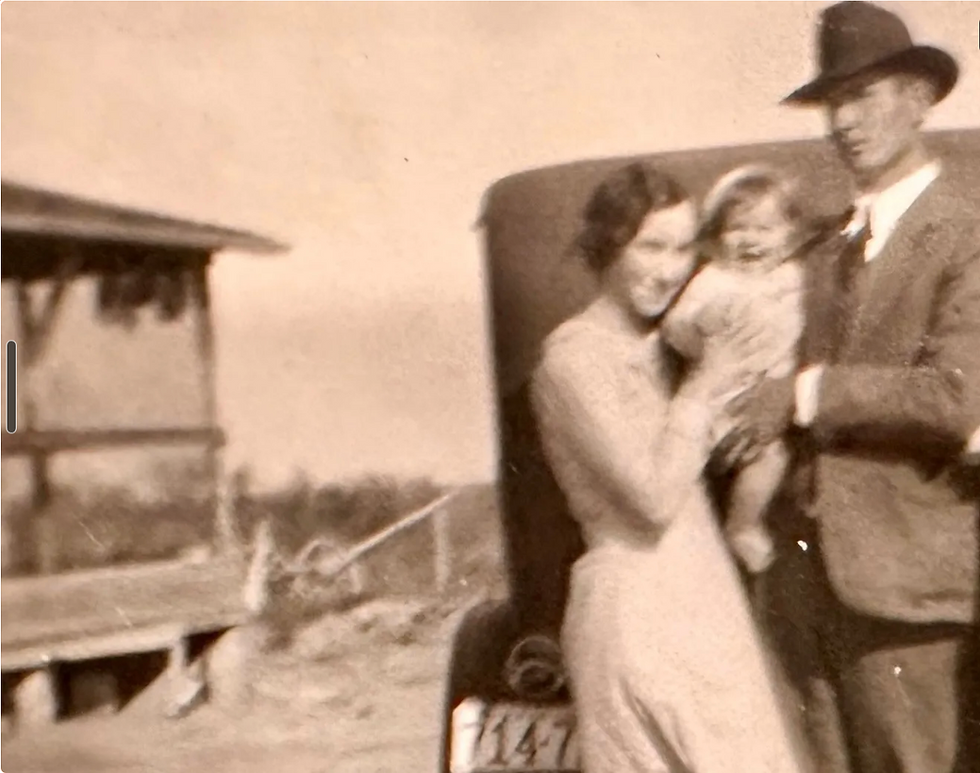
My grandparents, Mamma and Granddaddy Williamson, with my mother, in West Texas.
“Contribute to the needs of the saints, and seek to show hospitality.”—Romans 12:13
My maternal grandparents eloped on Leap Year Day during the Depression. Granddaddy liked to say that suited him just fine because he could only afford an anniversary every four years anyway.
They lived on the rugged plains of West Texas, where life demanded resilience, and no one waited for ideal circumstances before inviting people over. Their gatherings were not elaborate, but there always seemed to be a party taking place in their home.
Card tables appeared when more seats were needed. Music played. Cousins ran in and out. The back screen door stayed propped open so we could smell Granddad’s barbeque pork chops cooking outside. Their home was full of people, motion, laughter, and life.
One of my favorite stories happened when Mamma and Granddaddy were newlyweds. They invited another couple to share a meal, even though Mamma did not have enough utensils to set the table for four. She gave their guests complete place settings, but she and Granddaddy had to share the remaining knife. They took turns cutting their food and passing it beneath the table so no one would notice. Their guests received the best they could offer, and what was missing did not keep them from opening their door.
That story has stayed with me because it captures the heart of hospitality. Mamma did not wait until she owned four complete place settings. She did not decide that her home, her table, or her possessions were inadequate. She saw people she could welcome and refused to let her own limitations stand in the way.
We sometimes treat entertaining and hospitality as though they are the same thing. They are related, but they are not interchangeable.
Entertaining is the how. It includes the china, flowers, menu, music, candles, wine, and all the details that create a beautiful gathering. These things can bring delight to our guests. They communicate that we prepared for their arrival and considered their comfort.
Hospitality is the why. It feeds the hungry, welcomes the lonely, listens to the brokenhearted, celebrates another person’s joy, and makes room for someone who just needs to belong.
The trouble begins when the how becomes more important than the why.
A lovely table can serve hospitality, but it cannot replace it. Neither the flowers nor the food can make a guest feel loved if the hostess spends the evening worried about how everything looks. A spotless house cannot create connection if we are too distracted to listen. The finest china in the cabinet has little value if our fear of using it, or fear of failing to use it correctly, keeps the door closed.
On the other hand, dismissing every detail does not make us more hospitable. Preparation matters. Cleaning the house, planning the meal, setting the table, and dressing for dinner are ways of saying, “Your presence matters enough for me to prepare.”
We do not have to choose between beauty and warmth. We can merge the two as long as we remember which one must always lead. Hospitality must always lead.
Some people love to host. They enjoy choosing flowers, planning menus, folding napkins, and deciding which glasses belong beside each plate. If that is your gift, use it generously. God gives us gifts so that we may serve others, not draw attention to ourselves.
Others insist that hosting is not their gift. They feel uneasy cooking for people, worry about conversation, or believe their home is not large or attractive enough.
Yet Romans does not tell us to practice hospitality only when it comes naturally. Scripture tells us to seek it.
Those of us who enjoy entertaining must guard against making the gathering about ourselves. Those who avoid entertaining must guard against allowing discomfort to keep us from serving others. In both cases, our attention can become fixed on the same person: ourselves.
The questions may sound different, but the focus is the same.
Will people be impressed with me?
Will people judge me?
Hospitality asks a better question:
Who needs to be welcomed?
The answer may be a neighbor who recently moved to town, a couple walking through a difficult season, a widow who eats most meals alone, or a family whose calendar has become so crowded that they have forgotten how much they need one another.
We do not need to begin with a dinner party for twenty. We can begin with one invitation, one meal, and one open seat at the table.
Much of Christ’s ministry took place through meals and gatherings. He attended a wedding feast, fed thousands, dined with religious leaders, sat with tax collectors, and shared the Passover meal with His disciples.
The settings changed, but His purpose remained. He used the table to teach, challenge, restore, and love. That should tell us something about the power of gathering.
A shared meal creates a natural pause in the pace of life. People sit down. They face one another. Conversations deepen. A person who might hesitate to ask for help can find the courage to speak. Someone who feels overlooked can discover that another person remembered her name and saved her a seat.
Never discount the power of a good party. A gathering filled with beauty and joy can be a profound act of service when its purpose is to honor the people in the room.
As important as it is to welcome friends, neighbors, and strangers, I believe hospitality begins with the people who live beneath our own roof.
How can we offer light to the world if we fail to shine it within our families?
The family table is one of God’s greatest classrooms. It is where children learn to listen without interrupting, speak with confidence, ask thoughtful questions, and care about someone else’s day. It is where families discuss future plans, work through disagreements, celebrate accomplishments, tend disappointments, laugh at old stories, and sometimes cry together.
The table anchors people. It creates focus and intention in a way few other places can.
When we protect time at the table, we are doing more than serving dinner. We are forming habits, building trust, passing down beliefs, and teaching the next generation how to belong to a family and eventually welcome others into their own homes.
The table shapes the home. The home shapes families. Families shape society.
If we want stronger communities, healthier relationships, and a culture in which people know how to care for one another, the work must begin inside our homes.
I love a beautifully set table. I enjoy the flowers, the candles, the china, and the anticipation of creating a memorable evening. Beauty can be a gift we offer our guests. But beauty is not the standard by which hospitality is measured.
The measure is whether people feel loved and welcomed. It is whether we paid attention when they spoke and gave them the sense that they belonged at our table.
This week, look at what is already in your hands. Do not wait for a different house or a more impressive menu, and do not wait until you think life will settle down. Invite someone for coffee this week. Add another chair to the family meal next Friday. Call the person who has been on your mind and ask her to dinner.
Open the door and use what you have. Someone needs a place at your table.
Together with you,
Lisa Lou


